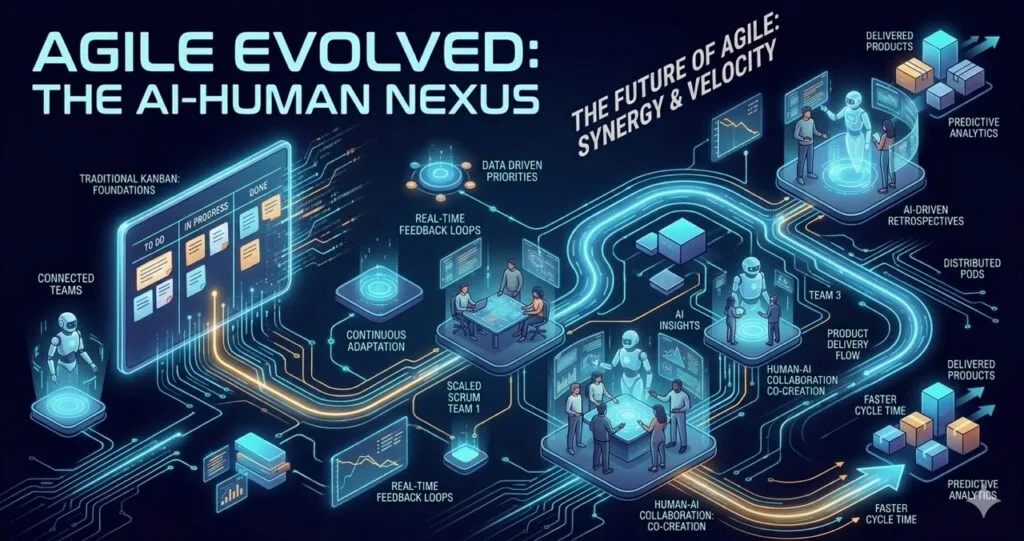
Scrum ceremonies help teams coordinate. An AI-driven operating system helps the whole company decide, execute, and learn—continuously, across value streams.
Executive summary
- Agile is shifting from “projects + ceremonies” to feedback loops that convert signals into outcomes, with AI in the loop.
- AI boosts local output, but delivery metrics can drop if quality, batching, and governance don’t evolve.
- Make the backlog live (signals → priorities) and automate flow with agentic AI—inside guardrails.
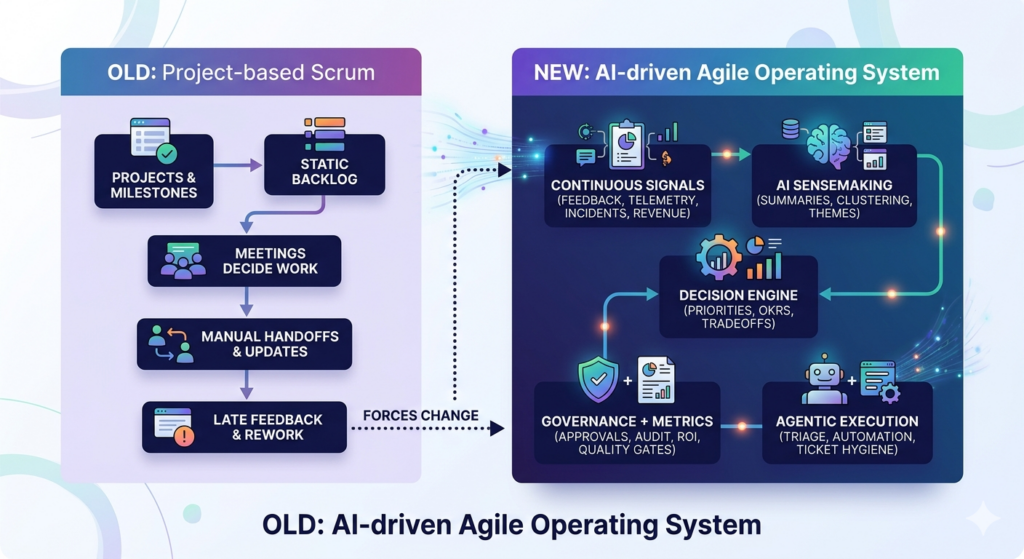
The thesis: Scrum rituals are not an operating system
If your “Agile transformation” lives in standups, you don’t have agility—you have recurring calendar invites.
The thesis is simple: AI is turning Agile into an operating model, not just a team practice. Oracle describes Fusion “agentic applications” as outcome-driven and able to make and execute decisions inside business processes using enterprise data, policies, approvals, permissions, and transactional context.
But here’s the uncomfortable part: speed isn’t performance. DORA’s 2025.2 research on generative AI found that higher AI adoption correlated with lower delivery throughput and (more notably) lower delivery stability—even while some process measures improved.
The blueprint: decision engine + flow optimizer + backlog-as-a-live-system
An “Agile operating system” is three connected parts.
Decision engine (what to do next).
A decision engine continuously ranks opportunities using fresh signals (customer pain, incidents, revenue impact, cost of delay, delivery risk) and makes tradeoffs visible. The goal is decision quality and decision latency—not prettier roadmaps.
This is where “backlog-as-a-live-system” becomes real: Atlassian’s Rovo agents include planning/decision support (OKRs, decision structure), plus analysis and work-item agents that theme, organize, and update work items (including moving items into sprints and assigning them to epics).
Flow optimizer (how work moves).
Flow optimization targets delays, handoffs, and interruptions. This is where AI earns its keep: triage, routing, completeness checks, blocker detection, “definition of ready” checks, ticket hygiene, and release-note drafting.
ServiceNow’s AI Agents positioning is explicit: agents can triage cases using sentiment and intent, gather missing information, and escalate complex issues to reduce manual triage and speed resolution.
Even IT ops is moving toward “less noise, more signal”—for example, Atlassian’s roadmap describes AI classification of alerts into signal vs. noise.
Agentic AI (doing the work, not just suggesting).
Agentic AI is the difference between “help me write this” and “go do this safely.” Oracle’s AI Agent Studio updates talk about orchestrating workflow execution with governance, plus observability and ROI measurement.
And yes, local productivity gains are real: Microsoft published a controlled study where developers completed a task 55.8% faster with GitHub Copilot. That’s great at the keyboard; it’s not a guarantee of faster, safer throughput-to-production.
Two real-world snapshots of the shift
ServiceNow: flow optimization through agentic workflows.
ServiceNow has described an internal-first approach: piloting genAI internally, iterating quickly with employee feedback, then rolling hardened capabilities into customer offerings. One profile notes the company said it launched 240+ AI use cases between 2023 and December 2025 and highlighted an AI-enhanced internal IT service desk as a standout success informing customer tools.
On the platform side, ServiceNow documents agentic workflows in AI Agent Studio (e.g., a “Triage cases” workflow) coordinating multiple agents and including traceability steps.
Oracle: decision engines inside the system of record.
Oracle positions Fusion Agentic Applications as coordinated teams of agents native to the transactional system, enabling real-time execution “with full governance,” including approvals and end-to-end traceability.
Reuters’ reporting adds the intent: humans ask for business outcomes while agents take on execution work like data gathering/entry and recommendations inside those processes.
What changes for leaders, product, and Scrum Masters
Leadership: stop asking “Which AI tool do we buy?” and start asking “What system are we building?” Make governance and measurement non‑negotiable—because the DORA data suggests speed without system design can backfire.
Product: roadmaps shift from contracts to hypotheses. Backlogs become live control panels fed by real signals and continuously re-ranked; your job is making tradeoffs explicit.
Scrum Masters: congratulations, you’re no longer a meeting DJ. You’re becoming a flow engineer: instrument the system, reduce WIP, design feedback loops, and help teams use agents without turning delivery into a slot machine.
Practical next steps (six-step checklist).
- Name your value streams and the outcomes that matter.
- Baseline flow + quality metrics before scaling AI (lead time, WIP, incident load, change failure rate).
- Build a “signal backbone” by connecting feedback, telemetry, support cases, and delivery data into auditable sources.
- Start with one decision loop (AI theme clustering + human review → updated epics/OKRs → recorded tradeoffs).
- Automate one choke point (triage/routing, blocker detection, readiness checks, release notes).
- Add guardrails early (permissions, approvals, traceability, and “stop buttons”), then scale.
Three provocative pull-quotes:
“If your roadmap is fixed, your AI will optimize the wrong thing faster.”
“AI won’t replace Scrum. It will replace the parts of Scrum you use as a coping mechanism for a broken system.”
“The future backlog isn’t a list. It’s a live control panel—with audit logs.”
Suggested LinkedIn post (≤280 chars):
AI isn’t “another Agile tool.” It’s turning Agile into the company operating system: continuous signals → decisions → automated execution → governance. Teams that keep Scrum as a meeting schedule will get outpaced by teams that build feedback loops. #Agile #AI #ProductManagement
Authoritative sources (2022–2026):
- Oracle Fusion Agentic Applications (press release, 2026-03-24).
- DORA: Impact of Generative AI in Software Development v.2025.2.
- Microsoft Research: Impact of AI on Developer Productivity (GitHub Copilot), 2023-02-13.
- Atlassian Support: Rovo out-of-the-box agents (updated 2026).
Links:
https://www.oracle.com/news/announcement/oracle-introduces-fusion-agentic-applications-2026-03-24/
https://services.google.com/fh/files/misc/dora-impact-of-generative-ai-in-software-development.pdf
The Impact of AI on Developer Productivity: Evidence from GitHub Copilot
https://support.atlassian.com/rovo/docs/atlassian-agents/