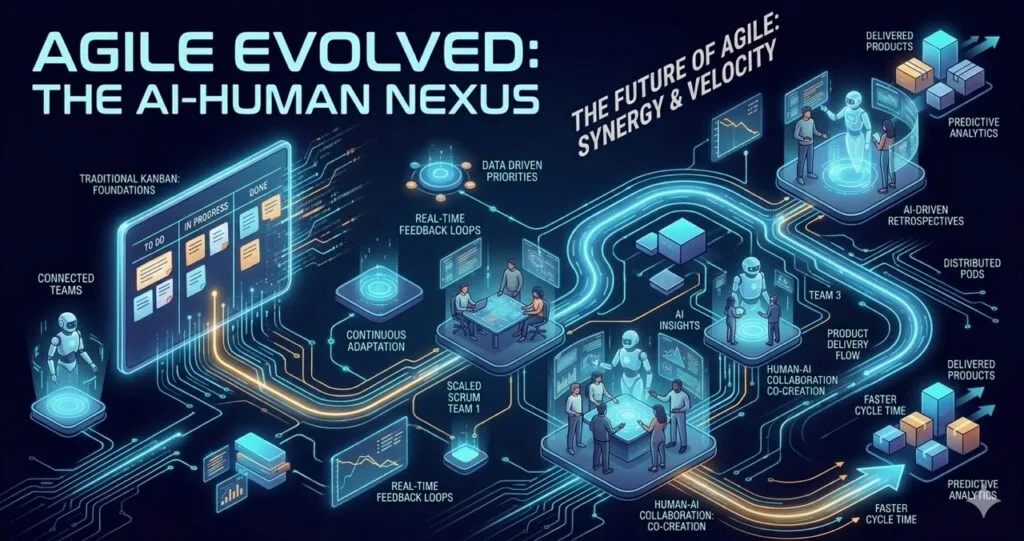
Scrum Masters play a pivotal role in guiding teams and ensuring successful project delivery in agile environments. However, amidst the constant focus on team achievements and client satisfaction, they often neglect to celebrate their own contributions and milestones. This oversight can lead to burnout and feelings of inadequacy. In this article, we’ll uncover the reasons behind this phenomenon and explore practical strategies for Scrum Masters to embrace their successes.
Understanding the Scrum Master’s Role
The Scrum Master’s job is to make good work easier. Not by directing tasks, but by shaping the system so the team can self-manage, learn fast, and deliver value predictably. Most of the job is facilitation, coaching, and quiet problem-solving that prevents small issues from becoming fires.
- Facilitate with intent: Turn events into outcomes—Sprint Planning that surfaces options and risks, Daily Scrums that re-plan the day, Reviews that invite real feedback, and Retrospectives that lead to one meaningful change each Sprint.
- Engineer team dynamics: Establish working agreements, create psychological safety, mediate conflict early, and normalize healthy dissent so decisions don’t stall or fester.
- Remove impediments beyond the team: Untangle dependencies, chase environments and approvals, work with vendors, and navigate policy to keep flow moving.
- Coach across roles: Help Product Owners focus on clear goals and thin slices of value, and help developers improve collaboration, estimation confidence, and quality practices.
- Guard the system of work: Visualize flow, watch WIP and cycle time, spot bottlenecks, and evolve policies like Definition of Done and WIP limits.
- Build capability: Run workshops, mentor new members, and make improvement experiments safe and small.
- Align stakeholders: Negotiate capacity, set expectations, and shield the team from scope whiplash without hiding reality.
When it goes well, the result looks like “nothing happened”—no escalations, smooth handoffs, steady delivery. That invisibility is a double-edged sword.
- Emotional labor without authority: Conflict mediation and coaching drain energy, especially when decisions sit elsewhere.
- Context switching: Supporting multiple teams and constant meetings erode focus and recovery time.
- Metric pressure: Velocity theater and misuse of KPIs push teams—and the Scrum Master—toward unhealthy trade-offs.
- Chronic firefighting: Systemic blockers outside one’s control create a high-demand, low-control environment—classic burnout fuel.
- Remote friction: Facilitation takes more prep; silence can mean disengagement, not agreement.
- Role ambiguity: “Servant leadership,” misread as “servant,” leads to undervaluing the work.
- Invisible wins: Success is the absence of problems, so recognition is rare.
Over time, the combination of emotional load, ambiguity, and unseen impact can exhaust even seasoned practitioners—especially when they’re not pausing to notice what they’ve actually made possible.
The Neglect of Self-Celebration
Scrum Masters often operate behind the curtain. The scoreboard at most companies rewards features shipped, revenue moved, or incidents closed—visible outcomes owned by others. The conditions that made those outcomes possible—healthy team dynamics, clear flow, thoughtful facilitation—don’t fit neatly on a dashboard. When success is measured by what the team does, the person enabling that success can start to feel like a ghost at their own party.
Several psychological patterns amplify this:
- Servant identity overreach: “It’s not about me” drifts into “It must never be about me,” making any self-recognition feel self-indulgent.
- Negativity bias: Brains remember the conflict that flared, not the dozen you prevented.
- Attribution drift: Wins are credited to “the team” (good), while stumbles feel personally owned (draining).
- Impostor effect: Because facilitation is intangible, it’s easy to discount it as “just common sense.”
- External-validation loop: If leaders only praise delivery metrics, you learn your work “doesn’t count.”
Workplace culture often compounds this. Metrics skew toward output over health. Meeting work is invisible work. Remote and async practices reduce the casual visibility that used to signal, “That was a good save.” Over time, the Scrum Master becomes the quiet safety net, thanked privately—if at all—when things don’t fall apart.
- Defusing a tense refinement so decisions happen without bruised egos.
- Reframing sprint goals so scope debates stop derailing focus.
- Untangling a dependency chain that cut lead time by a week.
- Coaching a new Product Owner to ask for outcomes, not tasks.
- Shielding the team from thrash during a leadership shuffle.
When these wins go unmarked, effort-reward imbalance sets in. You expend emotional labor without the mental “paycheck” of acknowledgment. That erodes motivation, nudges you toward over-functioning, and makes cynicism feel rational. The fix isn’t grandstanding; it’s making facilitation legible and giving yourself permission to notice progress. That starts with naming the kinds of value you create every week—so they can be recognized on purpose, not by accident.
Strategies for Self-Recognition
Self-recognition works best when it’s fast, visible, and tied to outcomes. As a Scrum Master, much of your impact is invisible—unblocked decisions, calmer meetings, cleaner flow—so make it tangible with small, consistent habits.
- Personal DoD for the Sprint. Set 2–3 outcome-based goals for yourself (e.g., “Reduce impediment lead time from 5 to 3 days” or “Try one facilitation experiment”). Review them before the team Retro, not after.
- Impact Log (3 minutes/day). Capture quick answers: What did I unblock? Where did I protect focus? What experiment did I run? Example: “Escalated API dependency; decision in 24h. Switched Standup to walk-the-board—less status, more flow.”
- Micro-metrics you control. Track a few lightweight signals: impediment lead time, decision latency, time reclaimed from meetings, WIP policy adherence, stakeholder escalations avoided. Use a simple sheet and trend weekly, not perfectly.
- Evidence-based brag doc. Keep a living document with short bullets and artifacts: screenshots, Retro notes, before/after metrics, quotes. Organize by themes (flow, team health, stakeholder alignment, coaching). This isn’t boasting; it’s memory.
- Peer mirrors. Pair monthly with another Scrum Master for 20 minutes using SBI (Situation–Behavior–Impact). Ask: “What did you notice I did that helped?” Trade one specific strength and one growth edge each.
- Micro-rituals of celebration. After tough facilitation, take two minutes: step outside, one deep breath, jot one win, send yourself a quick “well done” message. Treat small wins like reps at the gym—they compound.
- Boundary ledger. Record every time you protected WIP limits, said no to scope creep, or preserved focus time. Review on Fridays. Boundaries are invisible victories; make them countable.
- Create a visible lane for wins. Start a #wins channel or end-of-week thread. Post concise, outcome-framed notes: “Pulled decision forward by 2 days; team unblocked.” Invite the team to add theirs; model how to credit others while naming your role.
Once your own wins are visible and routine, it becomes easier to design team rituals that normalize celebration without grandstanding—and to help others do the same with clarity and ease.
Fostering a Culture of Celebration
A celebration culture doesn’t mean confetti at every standup. It means routinely noticing useful progress, naming it, and connecting it to outcomes. This keeps morale (and perspective) intact, especially when work is complex and the “big wins” are months away.
- Daily Scrum: Add a 60-second “micro-win” prompt: one person shares what moved the needle yesterday. Rotate who goes first to avoid the same voices. Use cues like “Who unblocked someone?” or “What made tomorrow easier?” to surface enabling work.
- Sprint Planning: Ask, “What will be worth celebrating in two weeks?” Capture one outcome per goal (e.g., “Reduce cycle time on reviews”). You’ll know what to look for later.
- Backlog Refinement: Tag a few items as “customer delight” or “risk retired.” When they’re delivered, call them out explicitly so small but strategic wins aren’t invisible.
- Sprint Review: Start with an “Impact minute”: three bullets on outcomes, not output (e.g., “Onboarding error rate dropped from 12% to 4%”). Invite stakeholders to name recognitions; the team hears value through the user’s voice.
- Retrospective: Run a round-robin appreciation: each person thanks someone for a specific behavior and impact. Add an “empty chair” prompt: “Whose behind-the-scenes work helped this sprint succeed?” to notice testing, ops, and facilitation.
- Impediment log: Showcase top impediments removed this sprint. It normalizes progress on systemic issues and makes facilitation work visible without chest-thumping.
For async moments, keep it lightweight: a #wins channel, a shared “Kudos board,” or a rotating “celebration host” who collects shout-outs for the review. Use peer-to-peer tokens or notes, not prizes, to avoid competition.
To inspire recognition without sounding boastful, frame contributions by impact and intent: “Because we simplified the deployment script, releases are 20 minutes faster.” Prefer “we” when teamwork made it possible and name enablers explicitly. Ask questions that invite others to notice: “What made this refactor safe?” Track who gets recognized over time and prompt for quieter voices.
Normalize learning wins, not just heroics: “The spike disproved our assumption early; we saved two sprints.” When these habits become routine, the team’s story naturally includes your own contributions—no spotlight required.
Conclusions
Burnout among Scrum Masters is often linked to a lack of self-recognition and celebration. By acknowledging their achievements and fostering a culture of self-celebration, Scrum Masters can not only enhance their own well-being but also set a positive example for their teams. Embracing successes, no matter how small, is crucial for maintaining motivation and preventing burnout. Let’s prioritize our achievements and support each other in this challenging yet rewarding journey.