
AI Agents in Scrum Teams: Who Is Responsible When They Mess Up?
AI agents can speed up Scrum work, but they do not own outcomes. Learn where human accountability ends, how to set guardrails, and what Scrum roles should change.
Arkadiusz Kozieł
AI agents are moving from novelty to everyday work support. They summarize meetings, draft documentation, update tickets, suggest priorities, generate code, and even trigger workflows across tools. That sounds efficient — until an AI makes a wrong call, misses context, or acts on incomplete data.
Then the uncomfortable question appears: who is responsible when the AI gets it wrong?
In Scrum Teams, that question cannot be ignored. Scrum is built on transparency, inspection, and adaptation. Those principles still apply when AI enters the workflow. In fact, they matter more, because AI can make bad assumptions look polished, fast, and convincing.
AI Agents Are Not Just Another Tool
For years, teams have relied on tools to support delivery. Jira tracks work, Confluence stores knowledge, Slack helps communication, and CI/CD pipelines automate releases. These tools assist the team, but they do not usually make independent decisions.
AI agents are different. They can take a goal, break it into steps, use connected tools, process data, and produce an output with very little human guidance. That makes them useful — and risky.
A simple assistant might say: “Here is a summary of the sprint.”
An AI agent may go further: “I analyzed the sprint data, identified blockers, updated the report, created action items, and suggested moving two items to the next sprint.”
That looks productive. It is also where problems begin. AI does not understand product context the way humans do. It may miss a hidden dependency, a political nuance, a technical constraint, or the reason why a seemingly small change is actually high risk.
The main danger is not that AI produces output. It is that teams may start treating that output as judgment.
Accountability Cannot Be Delegated
The biggest mistake teams can make is to confuse automation with responsibility. AI can support work, but it cannot own the outcome.
In Scrum, accountability is already clear:
- Developers are accountable for creating a usable Increment.
- The Product Owner is accountable for maximizing product value.
- The Scrum Master is accountable for establishing Scrum and helping the team improve.
None of these accountabilities change because AI enters the picture.
If AI helps refine backlog items, the Product Owner still owns the Product Backlog. If AI generates test cases, the Developers still own quality. If AI summarizes a retrospective, the Scrum Master still owns the safety and integrity of the process.
This matters because an organization can easily slide into “the system decided” thinking. But decisions made by AI are still decisions the team chose to accept. If no one validates them, then no one is actually accountable — and that is how delivery becomes fast and fragile.
Invisible Decisions Are the Real Risk
One of the biggest risks with AI agents is not dramatic failure. It is gradual normalization.
It starts with harmless use cases:
- summarizing meetings, - suggesting action items, - drafting backlog items, - generating reports, - ranking tasks by “importance.”
Over time, teams may stop questioning the output because it is “usually right enough.” That phrase is dangerous. In complex product work, usually right enough can still be expensive.
Scrum Teams work in uncertainty. Requirements change. Stakeholders disagree. Dependencies appear late. Technical debt hides in plain sight. AI can process signals faster than humans, but it does not automatically understand the full system.
It may not see that a quiet developer has a real concern but has not spoken up yet. It may not know that a small feature request is tied to a strategic customer relationship. It may not realize that a clean-looking plan is actually built on shaky assumptions.
That is why AI output must remain visible, traceable, and reviewable. A polished summary is not truth. A confident recommendation is not evidence.
How Scrum Roles Should Respond
AI does not replace Scrum roles. It changes how those roles operate.
Scrum Master: Protect transparency and learning
The Scrum Master should help the team define where AI is useful and where human judgment is mandatory. That means asking practical questions:
- What can AI safely support?
- Which decisions must remain human-owned?
- How do we verify AI-generated outputs?
- How do we prevent hidden automation from shaping decisions without review?
The Scrum Master does not need to become an ML engineer. But they do need enough AI literacy to spot risks in the process. AI can make good systems more efficient, but it also makes weak practices scale faster. If the team has poor refinement, weak collaboration, or fuzzy goals, AI will not fix that. It will accelerate it.
Product Owner: Use AI for input, not for judgment
Product Owners may use AI to analyze customer feedback, support tickets, usage trends, or delivery history. That can improve insight. But prioritization is not only a data exercise. It also involves strategy, timing, risk, and business context.
AI can recommend. The Product Owner still decides.
If the Product Owner blindly follows AI-ranked priorities, the team is not being data-driven. It is avoiding responsibility with better branding.
Developers: Keep ownership of quality
Developers can benefit a lot from AI in coding, refactoring, testing, and documentation. But they still own the technical outcome.
AI-generated code may contain hidden bugs, weak assumptions, insecure patterns, or logic that only works in a narrow context. Because the output often looks polished, review discipline becomes even more important.
Code review, testing, architecture alignment, and shared understanding cannot be replaced by a model producing plausible text. AI can accelerate development, but it should never become an invisible contributor that bypasses engineering discipline.
Practical Guardrails for AI-Enabled Scrum Teams
Teams using AI agents should make their working agreements explicit. A strong Definition of Done often needs a small but meaningful update.
For example:
- AI-generated code must be reviewed by a human.
- AI-generated documentation must be checked against the implementation.
- AI-generated test cases must be validated before use.
- AI-generated backlog suggestions must be reviewed by the Product Owner.
- AI-generated reports should include the source of data where possible.
These rules are not about slowing teams down. They are about keeping quality and accountability aligned.
A good practical standard is simple: if AI influenced the work, a human must verify the result before it can be treated as trustworthy.
Teams should also define where AI is not allowed to act autonomously. For example, changing priorities, moving backlog items, or triggering production-related workflows may require explicit human approval. The more impact a decision has, the less autonomy AI should have.
AI Literacy Is Now a Team Skill
Scrum Teams need a new capability: AI literacy.
That does not mean being excited about every new tool. It means understanding what AI is good at, where it fails, and how to use it without losing critical thinking.
A team with AI literacy knows:
- when AI output is useful and when it is misleading,
- how to validate suggestions, - how to keep humans accountable,
- how to preserve transparency in decision-making,
- how to avoid replacing judgment with convenience.
The best teams will not be the ones using the most AI. They will be the ones using AI deliberately. They will automate repetitive work, but keep humans in charge of decisions that affect product direction, quality, and trust.
AI Will Expose Fake Scrum
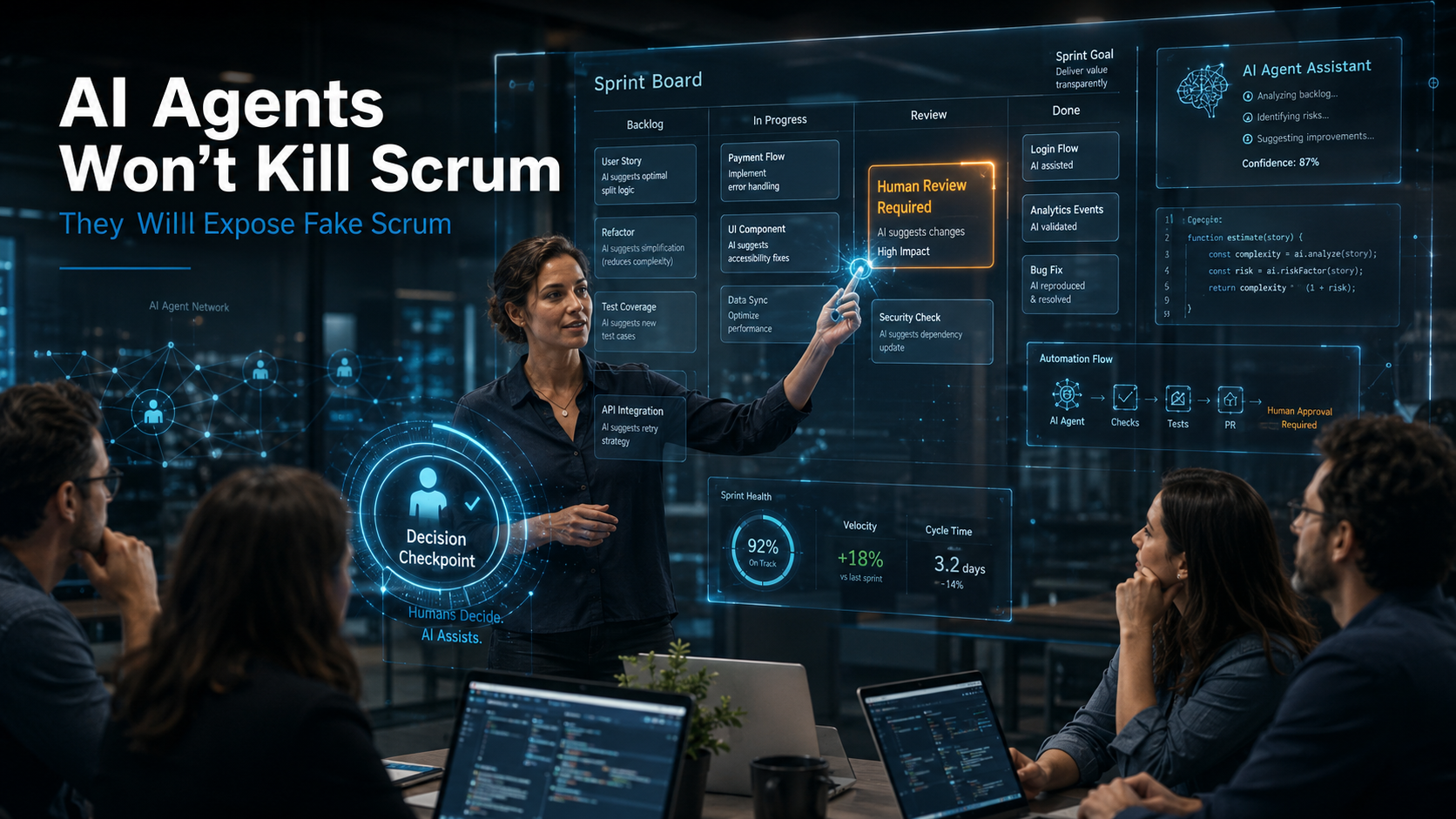
This is the uncomfortable truth: AI will not destroy Scrum. It will expose poor Scrum.
If a team is already living on ceremonies, status updates, and shallow reporting, AI will not save it. It may even make the illusion better. The summaries will be cleaner, the reports prettier, and the action items more organized — while the real issues remain untouched.
But if the team already values transparency, ownership, focus, inspection, and adaptation, AI can be a genuine advantage. It can reduce repetitive work, surface patterns, and free up time for the conversations and decisions that actually require people.
That is the real test. AI should amplify good Scrum, not hide weak Scrum.
Conclusion
AI agents are coming into Scrum Teams whether organizations are ready or not. The question is not whether to use them. The question is how to use them without losing accountability.
AI can suggest, summarize, generate, and automate. But humans still own the result.
When something fails in production, the customer will not care that the AI was confident. They will care that the system does not work.
So by all means, use AI agents in Scrum Teams. Let them reduce noise and support better decisions. But do not confuse assistance with responsibility.
That part still belongs to the team.