
How AI Is Transforming Scrum: Practical Use Cases for Agile Teams
Discover how AI tools are supercharging Scrum teams — from smarter sprint planning and backlog refinement to automated standups and AI-powered retrospectives. Practical insights for Scrum Masters, POs, and dev teams.
Arkadiusz Kozieł
Oh Great, Another Technology That’s Going to Revolutionize Agile
Every few years, something new arrives to finally fix the way software teams work. First it was Agile itself. Then it was SAFe (because apparently Agile wasn’t complicated enough). Then it was remote work tools, no-code platforms, and at least three different flavors of “the future of work.” So forgive the eye-roll when someone says AI is going to transform Scrum.
Except — and this is genuinely painful to admit — it kind of is. Not in the “replace your entire process with a chatbot” way the LinkedIn thought leaders are promising. But in the quiet, unglamorous way that actually makes a difference: better data, less busywork, and fewer meetings where everyone pretends they read the backlog.
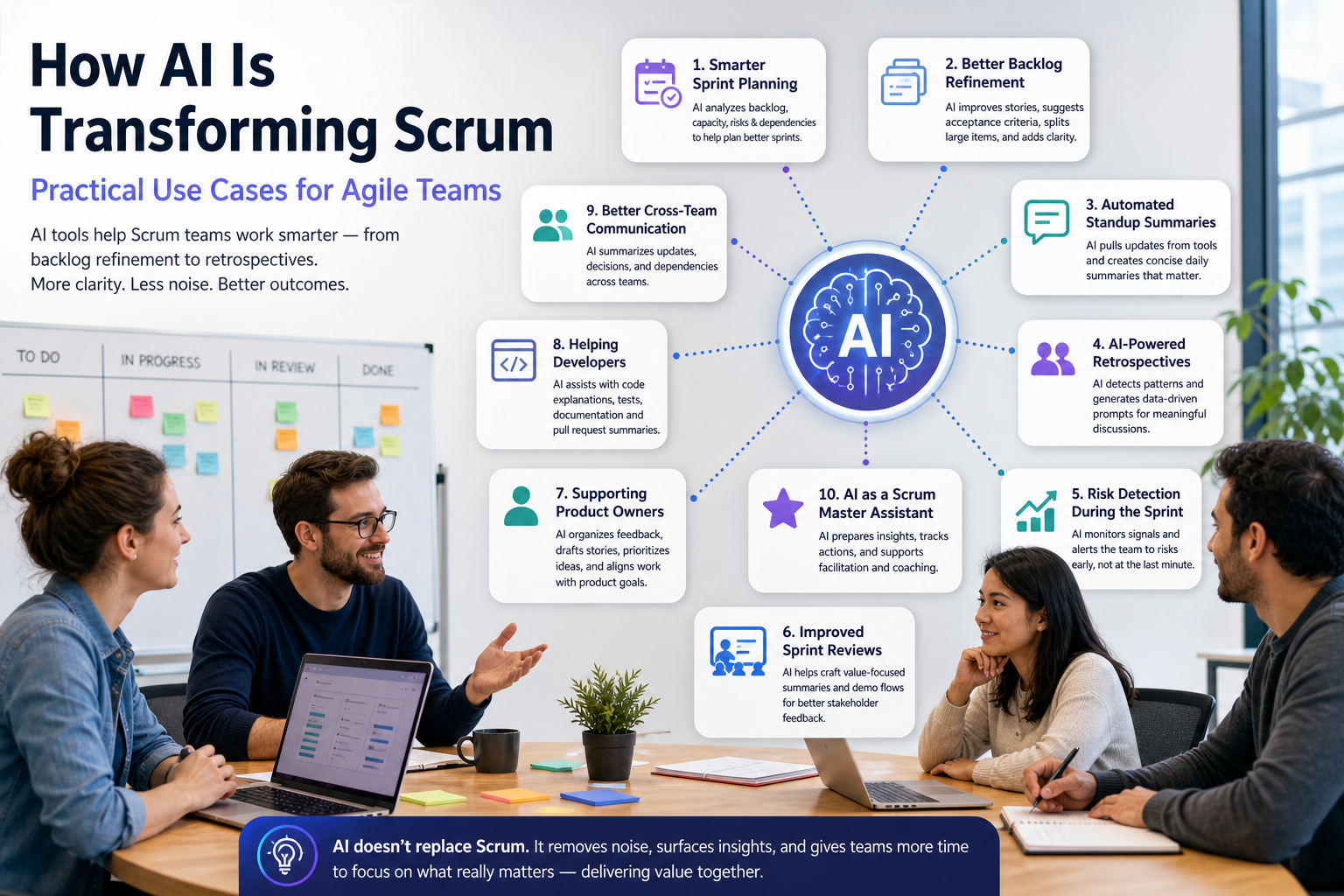
AI-Assisted Sprint Planning: Your Jira History Finally Has a Reader
Sprint planning is where optimism goes to die. The team commits to twelve story points more than they should, the PO insists that one “small” feature is definitely a two-pointer, and by day three of the sprint everyone quietly knows it’s already off the rails.
AI tools can now analyze your team’s velocity trends, historical delivery data, and individual capacity to suggest realistic sprint goals. They can flag when you’re overcommitting based on patterns you’ve been ignoring for six sprints. They can even account for upcoming holidays, known dependencies, and the fact that your lead developer always goes mysteriously quiet during sprint week.
Yes, it turns out a machine can read your Jira history better than your PO can. This is not an insult to your PO. It’s just that humans are optimistic creatures, and optimism is the enemy of a well-scoped sprint.
Smarter Backlog Refinement: Turning Three Words Into an Actual Ticket
Every team has them: the tickets that say something like “Fix login” or “Dashboard improvements” and have been sitting in the backlog since the Obama administration. Backlog refinement exists to address this. In practice, it often just means everyone stares at the ticket for twenty minutes and agrees it needs more detail — then moves on.
AI-assisted refinement tools can automatically generate acceptance criteria, suggest story splits based on complexity signals, and flag ambiguous language before it becomes a sprint-day argument. Some tools can even draft user stories from rough feature descriptions, giving your team something concrete to react to rather than a blank page.
Finally — finally — something that can turn a three-word ticket into an actual definition of done. The bar was low. AI cleared it.
Automated Daily Standups: A Blessing, a Threat, or Both
The daily standup was supposed to be fifteen minutes. It is never fifteen minutes. Someone always has “just one quick thing” that turns into a twenty-minute architectural debate, and the person who actually has a blocker never mentions it because they don’t want to look bad in front of the team.
AI tools can now aggregate async updates from Slack, Jira, and GitHub, automatically summarize progress, identify blockers based on inactivity or flagged comments, and generate a standup report that the team can review asynchronously. No meeting required. No performative “I’m working on the same thing as yesterday.”
For teams who’ve been quietly lying in standups for years — saying “no blockers” when there are very much blockers — this is either a blessing or a threat. Probably both. The machine doesn’t care about your feelings. It just reports what it sees.
AI-Powered Retrospectives: The Mirror You Didn’t Ask For
Retrospectives are where teams go to feel good about themselves for an hour and then change nothing. The sticky notes go up, someone writes “better communication” for the fourteenth time, and the action items get assigned to people who will forget about them before the next sprint starts.
AI can now perform sentiment analysis on retro feedback, detect recurring patterns across multiple retrospectives, and suggest targeted action items based on what’s actually been said — not just what the loudest person in the room thinks. It can tell you that “communication issues” have been your top retro theme for eighteen months straight, and that the three action items you generated last quarter were never completed.
This is uncomfortable. It is also extremely useful. A good retrospective should make you slightly uncomfortable. Now the machine can do it for you, without the awkward silence.
The Elephant in the Room: Will AI Replace Scrum Masters?
Let’s address it directly: no, AI is not going to replace Scrum Masters or Product Owners. Not because the technology isn’t capable of handling some of the work — it clearly is — but because the real job of a Scrum Master isn’t running ceremonies. It’s building psychological safety, navigating team dynamics, coaching individuals through conflict, and knowing when to push back on leadership.
No language model is going to tell your VP of Engineering that the deadline is unrealistic. No AI is going to sit with a developer who’s burning out and figure out what’s actually going on. The human parts of the job are still human.
What AI will do is expose the Scrum Masters and POs who were just running meetings and calling it leadership. If your entire value-add is facilitating a standup and updating a board, that’s a problem — and it was a problem before AI arrived. The tools just make it more visible.
So Here’s the Honest Take
AI won’t fix your broken team culture. It won’t resolve the tension between your engineering team and your stakeholders. It won’t make your roadmap coherent or your estimates accurate or your retrospectives actually lead to change.
But it will give you better data to argue about. It will surface patterns you’ve been ignoring. It will take the tedious, repetitive parts of Scrum — the ticket grooming, the velocity tracking, the standup summaries — and handle them quietly in the background, freeing up your team to focus on the work that actually requires human judgment.
That’s not revolutionary. It’s just useful. And after years of tools that promised to transform everything and delivered a new dashboard nobody checks, useful is more than enough.