
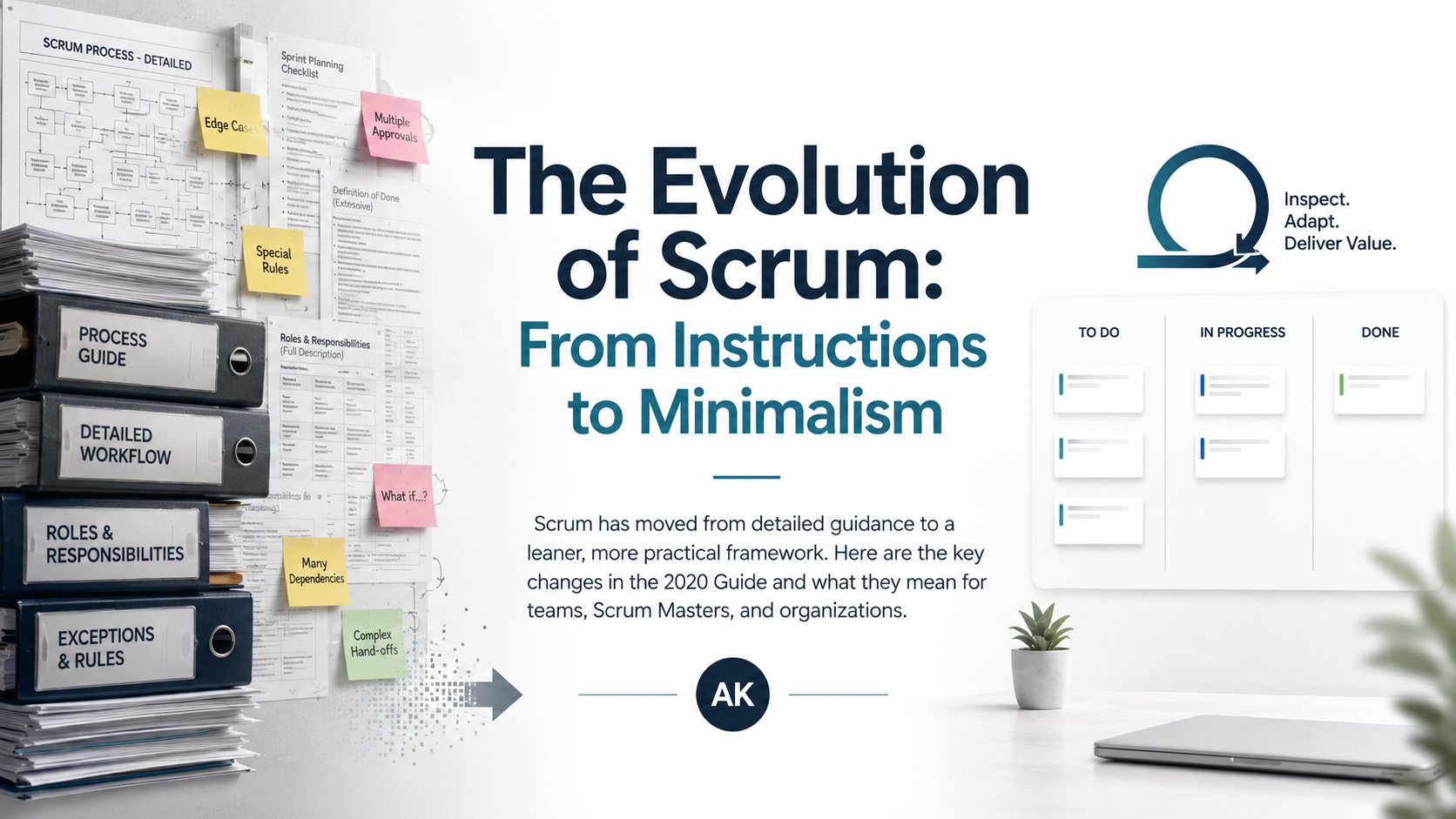
The Evolution of Scrum: From Instructions to Minimalism
Scrum has moved from detailed guidance to a leaner, more practical framework. Here are the key changes in the 2020 Guide and what they mean for teams, Scrum Masters, and organizations.
Arkadiusz Kozieł
Scrum has never been static. What started as a lightweight way to manage complexity has been refined over the years into a framework that is easier to apply, but also more precise in its intent. The 2020 Scrum Guide was not a revolution in substance as much as a reset in language: fewer instructions, less software-specific wording, and a stronger focus on outcomes, accountability, and empirical collaboration.
For teams preparing for certification or simply trying to work better, understanding this evolution matters. The changes are not cosmetic. They influence how we define responsibility, how we plan work, and how we think about leadership in a Scrum environment.
From detailed guidance to a minimal framework
Scrum emerged in the early 1990s and was formalized over time through the Scrum Guide, first published in 2010. Earlier versions tended to explain Scrum in a more instructional way, often adding detail to reduce ambiguity. That approach helped adoption, but it also made the framework feel more prescriptive than it needed to be.
The 2020 Guide moved in the opposite direction. Its authors intentionally made Scrum minimal yet sufficient. The goal was not to remove structure, but to remove unnecessary language and assumptions. Instead of describing every possible implementation, the Guide now focuses on the essential elements that make Scrum work: transparency, inspection, adaptation, and clear accountability.
This shift matters because many teams do not fail due to lack of process. They fail because process becomes too rigid, too verbose, or too tied to one domain. Scrum 2020 encourages teams to use the framework as a strong backbone, not as a script.
Roles and accountability became clearer
One of the most visible changes was the removal of the term Development Team. In its place, Scrum now speaks of one Scrum Team, composed of the Product Owner, the Scrum Master, and the Developers. That may look like a wording update, but in practice it addresses a real organizational problem: the tendency to create an artificial split between “the team” and “the rest.”
By using one unified team concept, Scrum pushes organizations toward shared ownership. The Developers are no longer framed as a separate subgroup. Everyone in the Scrum Team is accountable for the same product goal and the same empirical process.
Another important shift is the move from self-organizing to self-managing. Earlier Scrum language emphasized that teams decide who does what and how. The 2020 version goes further: the team also decides what work is taken and how it is approached within the boundaries of the framework and organizational constraints.
That distinction is important for managers and Scrum Masters. Self-management does not mean absence of leadership. It means the team is trusted to make more of the operational decisions needed to deliver value effectively.
New commitments made Scrum more outcome-driven
The 2020 Guide introduced a clearer structure around commitments attached to Scrum artifacts. This is one of the most meaningful changes because it strengthens the connection between planning and purpose.
Product Goal
The Product Goal is a long-term objective for the Product Backlog. It gives the backlog direction. Without it, the backlog can become a random list of requests, bugs, ideas, and dependencies. With it, the backlog becomes a means to achieve something specific.
Sprint Goal
The Sprint Goal is the commitment for the Sprint Backlog. It helps the team focus on the outcome of the Sprint instead of treating the Sprint as a bundle of unrelated tasks. This improves flexibility: if the team understands the goal, it can adapt the plan without losing direction.
Definition of Done
The Definition of Done is the commitment to the Increment. It ensures that every increment is potentially usable and assessed against a clear quality standard. This is especially important in technical environments, where incomplete work often hides in the system and creates future rework.
These commitments reduce one of the most common anti-patterns in Scrum: confusing activity with progress. A team can be very busy and still deliver little value. Commitments help shift attention from output to meaningful outcomes.
Scrum Master as a true leader
The role of the Scrum Master was also reworded in a significant way. In older versions, the Scrum Master was described as a servant-leader. In 2020, the Guide states that the Scrum Master is a true leader who serves.
This is more than a stylistic choice. It reflects a more mature view of leadership. A Scrum Master is not a passive facilitator waiting for the team to ask for help. The role requires active influence, systems thinking, and the courage to work on organizational impediments, not just team-level issues.
The Guide also changed the language around impediments. The Scrum Master is no longer described as someone who personally removes obstacles, but as someone who causes impediments to be removed. That difference is practical. Most serious blockers are organizational, not local. A strong Scrum Master works through coaching, escalation, negotiation, and change management to address the root cause rather than treating symptoms.
For practitioners, this is a valuable reminder: Scrum Mastery is not administrative support. It is leadership in service of team effectiveness and organizational learning.
Sprint Planning now starts with why
Sprint Planning gained a clearer structure in Scrum 2020. The event now explicitly addresses three questions:
- Why is this Sprint valuable?
- What can be done in this Sprint?
- How will the chosen work get done?
The first question, why, is especially important. It forces the team to define the purpose of the Sprint before discussing tasks and capacity. That helps avoid mechanical planning sessions where people simply pull items from the backlog until time runs out.
In practice, this change improves alignment between Product Owner, Developers, and Scrum Master. The Sprint Goal becomes the anchor for the conversation. When teams know why the Sprint matters, they make better trade-offs, resolve scope more intelligently, and adapt faster when reality changes.
Scrum became more universal
Another subtle but important evolution is the removal of terminology that was overly tied to software development. Scrum is still widely used in product development, but the 2020 Guide deliberately avoids language that would limit its applicability to IT only.
That makes sense. The framework is meant for complex work, not just code. Teams in marketing, operations, hardware, research, and service design can benefit from the same empirical approach, provided they truly face uncertainty and need frequent feedback.
The less software-specific language also improves discipline. When a framework is described too narrowly, teams start to treat it as a process template instead of a way of thinking. Scrum 2020 pushes the opposite direction: focus on empiricism, accountability, and value delivery, regardless of industry.
What this means in practice
If you work with Scrum today, the most important lesson is not memorizing updated terms. It is understanding the intent behind them.
The 2020 Guide asks teams to be:
- clearer about goals and commitments,
- leaner in how they describe the framework,
- more accountable in how responsibilities are shared,
- more adaptive in how they plan and inspect work.
For Scrum Masters, the message is equally clear: lead the system, not only the meetings. For Product Owners, the Product Goal is a tool for strategic focus. For Developers, self-management means more ownership, not less structure. And for managers, Scrum works best when they stop expecting control through detailed instructions and start enabling decision-making close to the work.
The evolution of Scrum from instructions to minimalism is not about doing less. It is about removing noise so the essential parts can do their job. That is why the 2020 Guide remains relevant: it gives teams enough structure to collaborate effectively, but enough freedom to solve real problems in real contexts.